// Lesson 30 of 49 · IP routing
OSPF concepts
OSPF (Open Shortest Path First) is the most common interior routing protocol in enterprise networks. It is an open standard (OSPFv2 for IPv4, OSPFv3 for IPv6).
Link-state in one picture
Every OSPF router describes its own links in LSAs (link-state advertisements) and floods them to all routers in the area. Each router builds the same link-state database (LSDB) — a map of the area — and runs the SPF (Dijkstra) algorithm to calculate the shortest path to every network. Changes are flooded immediately, so convergence is fast.
Router ID
Every OSPF router needs a unique 32-bit router ID (RID), chosen in this order:
- Configured with
router-id. - Highest IP address on a loopback interface.
- Highest IP address on any active interface.
Always configure it explicitly — it makes troubleshooting much easier. A changed router ID takes effect only after clear ip ospf process.
Neighbours and adjacency
Routers discover each other with Hello packets sent to 224.0.0.5. To become neighbours, these must match:
- Area ID
- Subnet and mask on the shared link
- Hello and dead intervals (defaults 10 s / 40 s on Ethernet)
- Authentication (if used)
- Stub area flags
- MTU (otherwise they get stuck in EXSTART/EXCHANGE)
Router IDs must be different.
Neighbour states: Down → Init → 2-Way → ExStart → Exchange → Loading → Full. FULL means the databases are synchronised.
DR and BDR
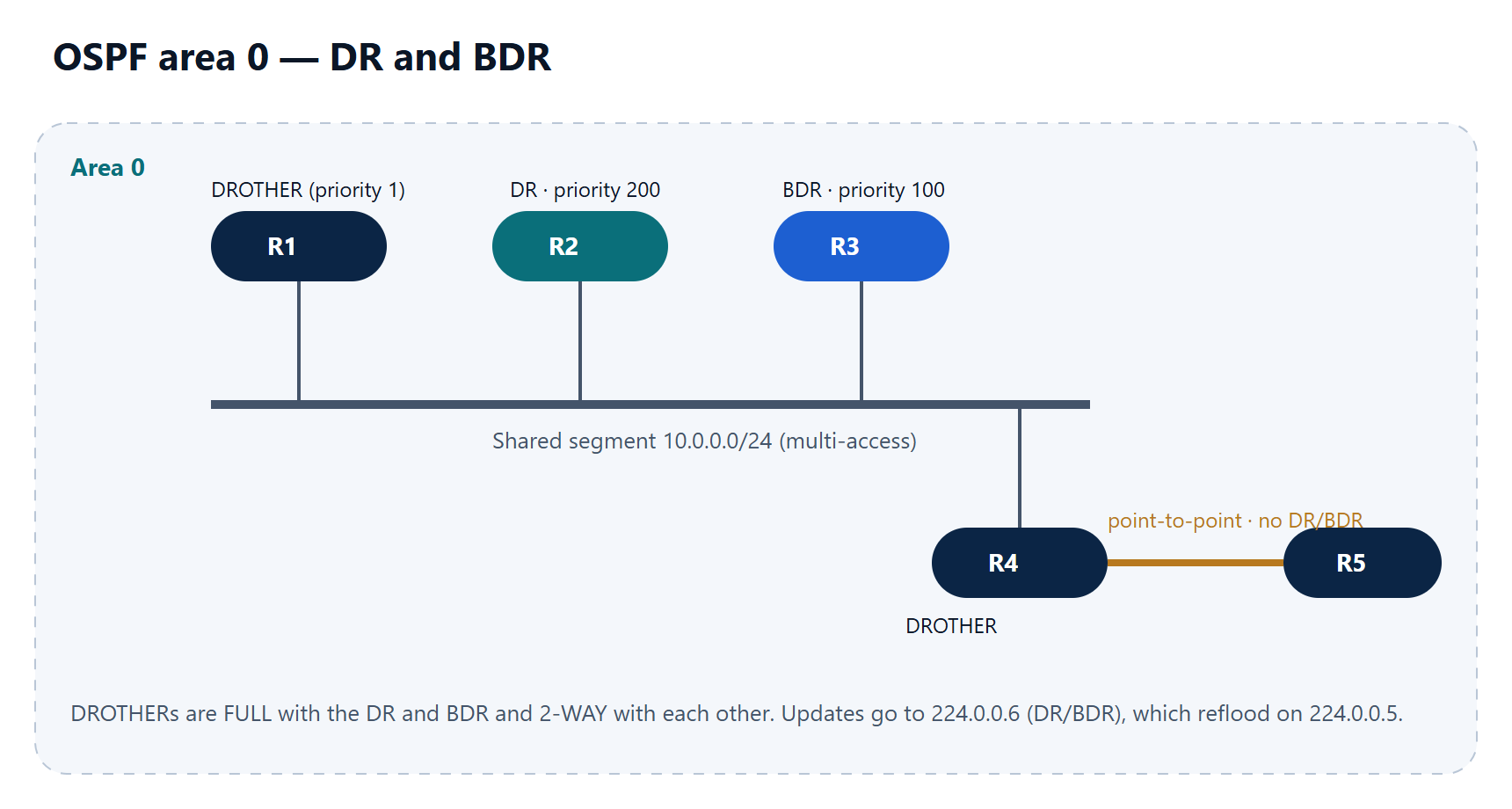
On multi-access networks such as Ethernet segments, every router becoming fully adjacent with every other would create a lot of flooding. Instead, OSPF elects a Designated Router (DR) and a Backup DR (BDR):
- All routers form FULL adjacencies only with the DR and BDR (with each other they stay 2-WAY, called DROTHERs).
- Updates go to the DR/BDR on 224.0.0.6; the DR refloods them to 224.0.0.5.
- Election: highest interface priority (default 1; 0 = never DR), then highest router ID.
- The election is not pre-emptive: a better router joining later does not take over until the DR fails or OSPF restarts.
On point-to-point links (and links configured as ip ospf network point-to-point) there is no DR/BDR — a sensible choice for links between two routers.
Areas
Large OSPF networks are split into areas to limit flooding. Area 0 (backbone) connects all other areas; routers linking areas are ABRs, routers connecting to other routing domains are ASBRs. The CCNA focuses on single-area OSPF; multi-area designs and LSA types are covered in CCNP.
Cost
OSPF's metric is cost = reference bandwidth ÷ interface bandwidth. The default reference bandwidth is 100 Mbps, so FastEthernet, Gigabit and 10 Gigabit all get cost 1 — not useful today. Set the same higher reference on every router:
R1(config-router)# auto-cost reference-bandwidth 100000 ! in Mbps = 100 Gbps
The route's total cost is the sum of the outgoing interface costs along the path.
Key points
- Link-state: LSAs → identical LSDB → SPF per router.
- Neighbours need matching area, subnet, timers, authentication and MTU; different router IDs.
- DR/BDR on multi-access links; priority then router ID; not pre-emptive.
- Cost = reference bandwidth / interface bandwidth; raise the reference bandwidth everywhere.
Sign in to save your lesson progress across devices. You can read every published lesson without an account.